Showing posts with label Cars. Show all posts

Tuesday, August 14, 2018

Plasti-Dip Chevy Volt Emblems and Rims

Now that I have had my Chevy Volt for a week, I had to take care of some high priority items in order to make it driveable.  The first one, of course, was to black out the rims and gold Chevy emblems.


I used a product called Custom Wrap by Dupli-Color. It's the equivalent of a better-known product called Plasti-Dip.  You spray it on, and it peels or wipes off when you want it to (assuming you did it right).  

Wheels 

Started with some serious cleaning of the wheels.  I used Simple Green mixed with water, a sponge, and a lot of elbow grease. I chose to remove the wheels for application, but that is not expressly necessary.  In my case I didn't want to worry about over-spray onto the car or rotors, and felt I could do a better job of getting all the nooks and crannies.  I didn't mask anything at all; I just made sure to do lots of (4-5) coats on everything (including the tires) so it would peel nicely off.  The whole wheels job used 2 cans.  I put the wheels on top of an old tarp before spraying, because I heard this stuff does not come off of concrete or asphalt.  When I was done, I put the wheels on the car and drove it 100+ miles.  After that, most of the over-spray onto the tires was gone, and the rest peeled off easily.  I am the king of laziness.

Emblems

I took a little more care here and made a basic mask out of cardboard and masking tape.  I don't have any photos, but on each I basically sprayed the entire emblem plus a box about 1-2" around them.  After it dried I peeled off all of the parts I didn't want blacked out. On the front emblem, I just changed the inner bowtie from gold to black (why does Chevy still insist on having gold logos on a chrome grill?)  On the back, I left it fully blacked out so it basically disappears into the black part of the trunk around it.

I am pretty happy with how all this came out. Time will tell as far as how long it lasts, but I hear it becomes pretty stable after one week - you can even take it through a touch car wash with no anxiety.


Wednesday, September 24, 2014

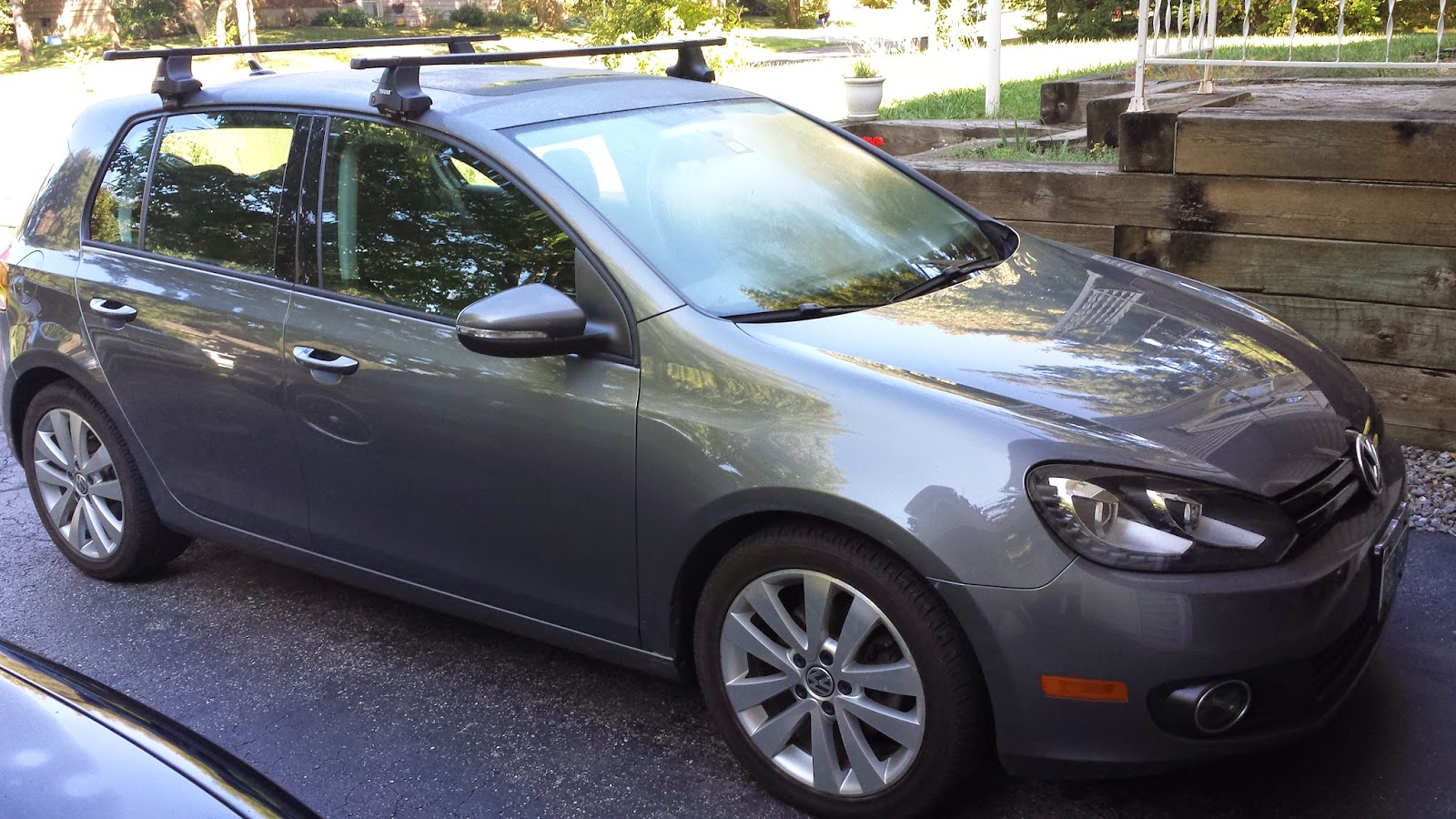
Got a new car

Well I did it.  Bit the bullet and, after thinking about lots of different possibilities, decided to go with what I know:

2013 VW Golf TDI with tech package.  It took me a while to find one, but as I learned from my last car, if you don't get what you want the first time, you'll spend the rest of your ownership trying to add it (and in many cases you still won't get it).

Here are some of the many features:

  • Heated seats (my previous car didn't have this and I regretted it for 12 years.)
  • Xenon headlights with "follow" action
  • LED DRLs
  • 17" rims
  • Dual power seats
  • Nav, SDcard slot
  • Bluetooth smartphone integration
  • Sunroof
  • DSG transmission (basically a standard transmission that is robotically automated)

It's going to take me a year or two just to get a handle on what is in this car.  I apparently have the RNS315 radio, which is different from the RNS516, but is apparently now standard on the tech package, I'm guessing because it's a little cheaper(?). This is the kind of stuff I am dealing with.

The only mod I've done so far is to rewire the lighter outlets so they are "always hot".  The new VW's have apparently finally gone to the dark side of shutting off the 12V outlets when the key is off.  It was driving me absolutely bonkers because every time I turned the car off my phone would reset, not to mention the fact that the battery wouldn't charge unless I left the ignition on.  I don't understand how the rest of the world can tolerate this.  My guess is that all the car manufacturers have gone to this standard because a few people managed to keep killing their car batteries, or starting fires.  Luckily it was pretty easy to rewire - no cutting wires, soldering, or even removal of any trim.  I am thinking about putting out a kit on eBay in case anyone else wants to do this.  If this sounds good, please let me know so I can gauge the interest level.

I'll be posting in the future with more details, but here are my (really) early impressions:

  • It's fast, but laggy (stomping it from stop = almost 3 seconds delay before launching)
  • Handling, on the other hand, is amazing - responsive yet very refined
  • Car tech has come a long way in the 12 years since I bought a car.
  • God help me if I ever have to fix this thing.
And for anyone who has this question on their mind, no I'm not planning to convert it to run on SVO. 

My 2002 Golf is for sale. It is clean, and, of course running the best it ever has.  I will miss it (almost as much as I will miss not having any car debt).  But I will have a LOT more free time. 

Friday, June 13, 2014

Euro Projector Headlights and Kamei Grill for the Golf

Woohoo!  I got something done on my car.  Had to go in yesterday and tighten up the connection between the counterweight and transmission gear selector (it came loose, probably was not torqued well enough when I replaced the transmission).  I decided, while I have the battery out, might as well take off the bumper and replace the headlights and grill.  This job ended up being a lot easier than I thought, because I had left the wiring there for my old custom fog lights.  Headlights are halogen projector type with OEM-style marker lights AND LED angel eyes.  I wired the angel eyes to a switch under my dash so I can turn them on/off, depending on how fancy I want to be.

I can't wait to be able to see where I am going at night.  My old headlight lenses were so scratched up that the beam was diffused.

Thursday, May 16, 2013

The Golf's 200K Rehab

Now that my car has rolled 200K, and I've decided the budget doesn't allow me to by my dream Golf anytime in the near future, I've been thinking about doing some other fairly serious rehab.  Over the last 11 years, there have been a lot of things that broke, rusted, burnt out, collected, or what-have-you in and on the car, and I think it's time to address a lot of it.  Since I drive this car so much, it has a chance to really improve my life.  The older I get, the more I realize investing time and money into things you use the most is time/money well spent.

So starting today, here's the partial list of rehab items as they came spewing forth.  I will be adding to this list as I think of things.


Exterior
  • Headlight lenses
  • Kamei mesh front grill
  • Rear spoiler
  • Rust repair - Fenders, hood, trunk, above windshield

Interior
  • Clean out glove box (remove tapes)
  • Fix rear defroster
  • Tint windows
  • Steering wheel
  • Design custom console around shifter/e-brake handle to house:
    • Triple 12V outlets & Remote for radar detector
    • OBD port
    • Inverter
    • Bluetooth receiver
    • Aux jack
    • Phone?

  • Permanent install/wire routing:
Radar detector
12V Triple outlet
12V Cooler
Bluetooth
Phone power
  • Driver side blown speaker
  • Driver side door switch
  • Trunk courtesy light
  • Install 12V cooler and 120v inverter

Engine
  • Pressure wash engine bay
  • Fix veg fuel line
  • Replace veg filter
  • Skid plate/Belly pan repair

Sunday, March 24, 2013

The Probe awakens early from its winter nap

Well just when I thought I'd finally gotten past this auto maintenance nightmare... What was only supposed to be an exciting couple of weeks in incoming baby-world (my wife is due next weekend), I have spent basically dealing with my cars.  I'll try to summarize the story as simply as possible.


Tuesday, March 12, 2013

Seal replaced, back on the road!


Last night things moved ahead considerably.  I was very happy to see that the replacement seal arrived priority mail (from idparts.com - they've never done me wrong) on Monday, after I ordered it on Friday night.  I also went out and found a seal puller (similar to the one pictured) at Sears, of all places.  None of the regular auto parts stores carry this thing for some reason.
The elusive seal puller I finally obtained.

Friday, March 08, 2013

Gears replaced, leak found!

Well, I was going to update this the other night, but sometimes there's only enough time to work on the car.  So a few things have happened since my last post: for one thing, I got the old gears off. 
 

Friday, March 01, 2013

Torn up gears, and a dead end for now

Well today I got the transmission cover off.  There were two gears in here (5th gear and the selector gear) that were totally rounded (all teeth were sheared off).

Thursday, February 28, 2013

Leaky Transmission

Well after a horrible stay at La Guardia airport for almost 12 hours, I am home and thinking about my car problems.  Tried to get into it after work today, which usually goes something like this:

Bye Bye, 5th Gear


It had to have been within 10 minutes of my staring at the odometer, marveling at the nearly 199,000 miles I had wracked up on my VW Golf and thinking how trouble-free the car had lately been, when my cruise control disengaged, and the car started to do the all-too-familiar "death coast".  Without thinking or trying anything else, I immediately turned on my four-way flashers and started moving into the breakdown lane -scoping the distance to the next rest area.

Monday, December 31, 2012

Diesel Haulin'

In the final days before the snowstorm, I managed get my act together and squeeze in the acquisition of half a cord of wood.  


Monday, June 23, 2008

Got a Small Car? Drive Carefully.

If you are the owner of a small, fuel efficient vehicle, here's something you may not have thought about. If you are involved in an accident that ends up totaling your car, you may not get enough insurance money to replace it.

Here's why: When the insurance company "totals" your car (decides it's cheaper to replace it than repair it), they will cut a check for the Blue Book value of the car. But, as the demand for these cars continues to rapidly increase, so does the "street" value (the amount the car is selling for today, on Ebay, for example). Since the Blue Book value of these cars is assessed using a fairly bureaucratic process, this value hasn't been calculated recently enough, and is therefore under the actual cost involved in acquiring an exact replacement.

Cost is only the beginning. The headaches of purchasing a fuel efficient vehicle are many- if you are in the market for a new car, you'll probably end up on a waiting list. When you do finally get your car, you'd better hope it comes the way you like it- because your other option is to wait some more.

If you're buying a used car, watch out. There are plenty of snakes out there who realize the inflated prices of fuel is the opportunity to fleece the public. They'll sell any small car they can get their hands on, knowing that SUV owners are bailing out and looking for something small to drive to work. They will gladly sell a car on its last legs for a few thousand dollars.

The worst case scenario is that you are driving a "banned" car. This includes highly efficient, diesel passenger cars such as the Volkswagen TDI. Despite their ability to achieve mileage in excess of 50 mpg, most of these cars have been banned from new sales due to high nitrous oxide and smog emissions. Replacing these cars will surely be a chore, as they are being retired from the road every day. On top of that, replacement parts are expensive, and knowledgeable labor is extremely hard to find.

The bottom line: drive carefully. Your car may not be insured to the extent you think it is, and even if it is, replacement can be more complicated due to our rapidly changing transportation economy.


Monday, June 09, 2008

GM Decides to Use Radical "Turbo" Technology to Make Fuel Efficient Car


GM has always answered the call for more horsepower by trying to find ways to shoehorn bigger engines in their large cars and trucks. For some reason, this wasteful practice has made Americans happy, as long as the fuel prices were low. However, now that its pickup and SUV sales have been obscured by a new demand for fuel efficient cars, GM finally has decided that it might be a good idea to give Americans a 120-140 horsepower vehicle, that still gets over 40 mpg!

Why wasn't this vehicle developed when gas was $2.00 something a gallon, and had every indication that there was no end in sight? Heck, why hasn't this vehicle existed for years as an American car choice?

Because the technology didn't exist? Wrong. Consumers of foreign manufactured autos have enjoyed lightweight, fuel efficient, and fast sport compact cars for years. How do they do it?

Turbochargers: They have been in use for over 80 years. By forcing air into the engine, power output can be significantly raised, or fuel efficiency, or both.

Why are GM and other American car manufacturers only now giving conservation-minded Americans the option of cake + eat? Because our economy has never rewarded anyone, manufacturer or consumer, for making fuel efficient choices. The only check built into our economy is the cost of gas.

Wednesday, June 04, 2008

Electric cars coming to the rescue in 2 years or less (No thanks to America)

Foreign auto manufacturers such as Nissan and Mitsubishi have responded to high oil prices by making small, 100% electric cars, slated for release in Japan (and even the U.S., in Nissan's case) by 2010.


GM has responded to high oil prices by closing 4 plants, laying off 30,000 workers, and leaving dealerships all over the nation to try to sell the Chevy Volt hybrid, with a $40,000 price tag.


Reportedly, the Th!nk City EV, now owned by a Norwegian company, will be coming back to the U.S in 2009. The car was originally developed by Ford, and dumped as part of its 2002 total abandonment of the electric car venture.

Thursday, May 22, 2008

The Prius - Now Getting (your favorite number of) Miles Per Gallon!

The other night, a friend asked me what I would do to make a car that got 100-something miles per gallon. This is a perfect example of how that question can be answered in a number of ways. This Prius has been outfitted with new technology LiFePO4 batteries, and has been recorded achieving 125+ mpg.

http://www.ecogeek.org/content/view/683/

Having better batteries means it can use more stored power before having to run the engine. While this is an improvement in city driving, on the highway commute this vehicle will be right back to 40mpg. Even the best batteries will be exhausted fairly quickly and the engine will end up running for the remainder of the trip.

Claims that the Prius achieves 499 MPG could be made just as easily and accurately if they measured the mileage on 1 mile test drive on a totally flat road, with no engine start or braking occurring. As far as I know, there is still no standard course for measuring these claims, and most of the time, no one understands the science well enough to question them.

I'm not trying to shoot down Toyota's efforts at making a more efficient car. In a sense, they have done this. However, as usual, press releases never seem to detail the nature of the improvements made, only the part everyone wants to hear. I suppose this is why I never made it in marketing.

Thursday, March 27, 2008

Bob Lutz: Leading the American Race for Capitalist Gluttony


Have you ever wondered exactly how America gets its reputation for driving oversized vehicles without any regard for the environment or fuel costs? Because people like Bob Lutz are behind the wheel of the largest American motor company: GM. We all know that GM is company that's as "American as apple pie."

Here's a timeline of events for you.

2004: Bob Lutz thinks that Hybrid cars make no sense. Quote:
"Hybrids are an interesting curiosity and we will do some," he said. "But do they make sense at $1.50 a gallon? No, they do not."
Understanding interaction between national and global economy: FAIL
Effectiveness at developing strategies that look more than 1-2 years out : FAIL

2005-2007: GM continues to bring products to market that it thinks will be good for America.

This includes pukemobiles such as:

The Chevy Suburban 2WD Z71
GMC Envoy Denali/Envoy XL Denali.
The Chevy TrailBlazer EXT
*and don't forget*
The Hummer H3

They are shoved in the face of Americans by GM via advertising on billboards, TV, and internet. GM makes so many of them that they are sold for next to nothing.

February, 2008: Bob Lutz thinks global warming is a "Total Crock of Shit"

March, 2008: Not making a hybrid car like the Prius was a "mistake"
No kidding.

Friday, March 07, 2008

Golf Diesel Hybrid for Everyone Except Us

As usual, some new, cool car technology is being developed which the U.S. will likely be (at best) the last to take advantage of. This time it's a diesel hybrid by VW. The diesel hybrid is not a new concept, but this will be one of the first production cars to incorporate it.

The fact is, diesel cars are awesome in so many ways. They are powerful, efficient, clean, and can be run on 100% renewable fuel with ZERO modification. Many other countries have embraced diesel vehicles. So why do they have such a hard time in the U.S.?

They are perceived by most to be "loud and smelly," to quote the Wired article. I will add that from my observations, people think they are dirty and underpowered. Now let's do some myth busting, shall we?

Myth: Diesels cars are Loud
Fact: Diesel trucks are loud. Old diesel anythings were often loud. My diesel is loud (since I riced out my exhaust system). But "Diesels" are not loud, at least not significantly louder than any gas car.

Myth: Diesel cars are smelly.
Fact: Catalytic converters shipped on current VWs produce a smell that is milder and more natural than the exhaust of a gas car.

Myth: Diesel cars are underpowered.
Fact: Some of them are underpowered (as with any car made), but especially so in the U.S. Often they are purposely power-castrated in order to meet the ridiculous Nitrous Oxide standards the cars are held to, which is all the California Emissions Nazis care about. Read on.

Myth: Diesel cars have terrible emissions.
Fact: Diesel hybrids could be used "in Europe to address tightening emissions regulations" (Quote from Wired Article). Diesels are very low emitters of CO2, which is what we should be focusing on.

Myth: Diesel cars can't/don't do what popular hybrids can, in order to address rising fuel costs and dwindling resources.
Fact: Under many conditions, regular (non-hybrid) diesel cars achieve the same average efficiency as hybrids such as the Prius and Civic (think 45-65 MPG). Now just think what these cars can do as hybrids. If that's not enough, check this out: diesels are the only vehicles that can be run on a 100% renewable fuel, OUT-OF-THE-BOX, with ZERO modifications!

So, I could go on, but like millions of other frustrated diesel fanatics, I think I've made my point. What is it going to take to get the point across to the masses?

The answer is simple.

First, let's look at some of the other simple crap that was used to convince people they need SUVs - which is what got us into this mess in the first place.


(special thanks to CommercialsIHate.com , with an awesome commentary on this particular commercial)

So I say, how about one of those hippy-dippy, white backgrounded, "think-different" commercials on a Hollywood trash channel that goes something like this: (Late 20-something, fashionably dressed woman with a British accent, standing in front of new diesel car)
"Diesels aren't smelly, loud or dirty anymore. They're fast, clean, and most importantly, your European fashion heroes are all driving them right now. Diesel: it's the new black!"
(Usual voice-over, phone number and website URL, financing percentages, etc. fade onto the screen.)

Or how about this: (Snoop-dogg standing in front of new diesel car)
"Y'all better be gettin' up on some of Deeeeeeezul-nuts."
(Usual voice-over, phone number and website URL, financing percentages, etc. fade onto the screen.)

Tuesday, June 19, 2007

Hydrogen is a widely misunderstood fuel.


Often I'm asked why I'm a proponent of vegetable oil as a fuel, rather than a fuel that doesn't emit CO2, such as Hydrogen.

Carbon neutrality is more important than to zero CO2 emissions at the tail pipe. Hydrogen is no more a fuel than are the batteries of an electric car- you put energy (electricity) in to make it, and it's then just a carrier of that energy for a vehicle. If the Hydrogen was produced using electricity from a nuclear power plant or coal plant, you still contributed new CO2 to the atmosphere.

Using plant mass as a fuel, however, is carbon neutral. When plants grow they convert CO2 to oxygen- the same amount that will be turned back into CO2 when it is used by cars. Thus, you could accurately say that a veggie car is, in some cases, less of a CO2 contributor than a Hydrogen car.

The promise Hydrogen offers is that of a better fueling infrastructure: one that will centralize energy conversion (and thus any CO2 production) to one location and source. Right now every single car is a separate problem, even if there really was some other choice (for the masses) to use instead of gasoline. When we convert fuel sources to clean energy carriers at one centralized location, the problems with those fuel sources become much more simple to deal with. For example, a hydrogen plant could, at any given time, be fueled by contributions from any or all of the following sources, based on supply, demand, and other various factors:

(carbon neutral)
Solar, Wind, hydro
Biomass
Biofuels

(not carbon neutral)
Nuclear
Coal, Oil
etc.

So, while Hydrogen offers a lot of hope for improvement in the future, the CO2 impact of using hydrogen itself is not really comparable to using vegetable oil to power your car. Furthermore, the benefits of Hydrogen are still a *long* way off.

Sunday, March 04, 2007

Why did SpeedTV dump WRC in favor of NASCAR?


I don't watch much TV, but there was a time when my roomies and I used to enjoy catching the weekly recap of the World Rally Championship, on SpeedTV (formerly Speedvision). For those of you who are unfamiliar, auto rally racing competitions are THE most hardcore, adrenalized motor sport, for both the participant and the viewer, on the planet. Sport compact cars with unbelievable power-to-weight ratios are dropped into the most grueling road conditions (snow, mud, you name it) and run the stages as fast as possible, with in-car cameras. The competition is on real, treacherous roads (no tracks!)


...And these cars turn left AND right, NASCAR fans.


The cars go so fast that they have a dedicated course note reader so the driver is prepared for the turns. See this video to get an idea of what it's like. The road conditions change rapidly and the team has to decide quickly and finally what tires to use, etc. The cars run one at a time so they don't have to worry about hitting each other- no yellow flags, red flags, no stopping. The only rule is get your car across the finish line as fast as possible, no matter what condition it's in. And believe me, these cars can be in pretty rough shape and keep going. Cars have been known to flip several times, land right side up - and it's game on.


Anyway, while the coverage was admittedly sparse, at least it wasn't non-existent. Over the years, NASCAR coverage continued to further dominate the programming on Speed, and finally in 2005 they dropped WRC all together. In fact, at this time, there is NO way to watch WRC coverage on TV in the US. This is amazing- an actual quote from a NASCAR fan on the VW Vortex forums: "I like NASCAR too, but I can't watch it 24/7."


If Rally racing is even slightly appealing to you... If you feel like you could be one of the millions of Americans missing out on some of the most exciting motor sports out there, I urge you to take 1 minute and Sign this petition to get other events besides NASCAR back on SpeedTV channel.

What does Suno mean for us producers & musicians?

 I've been thinking about this for a month or two now, and there is still a lot to process (obviously).  In a way for us musicians and p...